The sixteen principles

The principles of control.

Professor Wally Jay distilled a lifetime of innovation into sixteen guiding principles. Ten form the core of every technique. Six expand into advanced concepts. Together, they describe a complete system of leverage, flow, and control.

The Sixteen Principles of Small Circle Jujitsu
Core principle

Balance

Keep yours. Take theirs.

Balance is the first principle for a reason - without it, nothing else works. In Small Circle Jujitsu, you learn to maintain your own balance while systematically disrupting your opponent's. Every technique begins with positioning yourself in a stable, centred stance, and ends with your partner off-balance and unable to resist. It's not about strength; it's about understanding where weight falls and how to redirect it.
Core principles

The foundation.

Ten principles that underpin every technique in the system.

01
Balance

Balance

Keep yours. Take theirs.

Balance is the first principle for a reason - without it, nothing else works. In Small Circle Jujitsu, you learn to maintain your own balance while systematically disrupting your opponent's. Every technique begins with positioning yourself in a stable, centred stance, and ends with your partner off-balance and unable to resist. It's not about strength; it's about understanding where weight falls and how to redirect it.
02
Mobility & Stability

Mobility & Stability

Move freely, stay rooted.

Mobility and stability seem contradictory, but in Small Circle they work together. You need to move freely - stepping, pivoting, adjusting angle - while remaining grounded enough to apply technique with authority. A practitioner who is mobile but unstable gets swept. One who is stable but immobile gets flanked. The art is finding both at once.

03
Avoid the Head-On Collision of Forces

Avoid the Head-On Collision of Forces

Never meet force head-on. Redirect it.

This principle captures the philosophical heart of jujitsu: the gentle art. When force comes at you, don't meet it with equal force - you'll lose to anyone bigger or stronger. Instead, redirect it. Step offline. Blend with the energy. Let their power become your advantage. This is what makes Small Circle effective for practitioners of any size.

04
Mental Resistance & Distraction

Mental Resistance & Distraction

Occupy the mind, open the body.

Before a lock can be applied, the opponent's attention must be elsewhere. A tap to the face, a shift in grip, a sudden change of rhythm - these distractions create a window where the body's natural resistance drops. Professor Jay understood that technique alone isn't enough; you need to manage your opponent's focus as precisely as you manage their limbs.

05
Focus to the Smallest Point

Focus to the Smallest Point

Concentrate force where it counts.

The namesake principle. Instead of applying broad, diffuse pressure, concentrate your force into the smallest possible area. A wristlock applied across the whole hand is comfortable. The same energy focused through a single knuckle onto a precise point is devastating. This principle transforms adequate technique into something razor-sharp.

06
Energy Transfer

Energy Transfer

Send power through, not into.

Energy transfer is about transmitting force through the point of contact and into the opponent's structure, rather than simply pushing against them. Think of it like the difference between shoving a door and snapping a whip - the energy travels through the medium rather than dissipating at the surface. In joint locks, this means the force travels through the wrist into the elbow, shoulder, and spine.

07
Create a Base

Create a Base

Control begins from a strong foundation.

Every effective technique needs a base - a point of stabilisation from which leverage can be applied. In a wristlock, creating a base means securing the opponent's elbow or upper arm so the wrist has something to work against. Without a base, the opponent can simply move with the technique and escape. With one, they're pinned between two opposing forces.

08
Sticking, Control & Sensitivity

Sticking, Control & Sensitivity

Feel the opponent; never lose contact.

Once you have contact with an opponent, never break it unnecessarily. Sticking means maintaining a constant, sensitive connection - feeling their weight shifts, their resistance, their attempts to escape. This tactile awareness lets you respond instantly and flow from one technique to the next without losing control. It's the difference between grappling and truly controlling.

09
Rotational Momentum

Rotational Momentum

Turn the circle; let motion do the work.

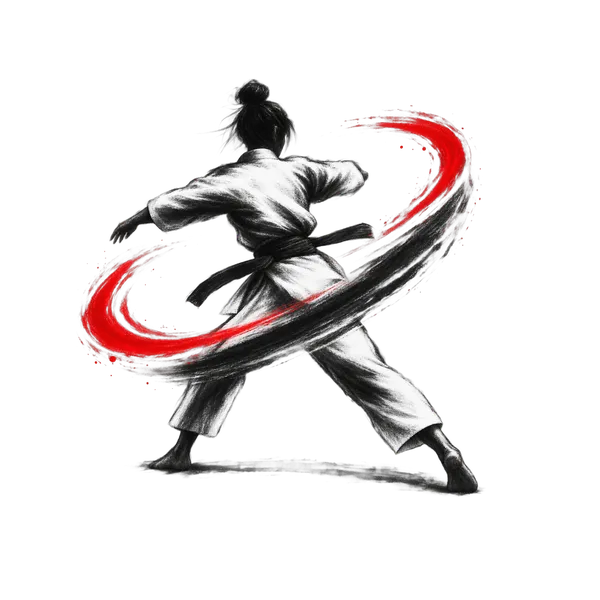
Small Circle Jujitsu is named for a reason. Rotational momentum - tight, efficient circular motion - is the engine that drives most techniques. By rotating around a small radius, you generate significant force with minimal effort. The smaller the circle, the faster the rotation, the greater the effect. This is why a well-executed Small Circle lock seems almost effortless to apply.

10
Transitional Flow

Transitional Flow

Move seamlessly, control to control.

No technique exists in isolation. Transitional flow is the ability to move seamlessly from one control to the next - without pausing, without releasing, without giving the opponent a moment to recover. If a wristlock fails, it becomes an armbar. If the armbar is resisted, it becomes a throw. The flow never stops; it just redirects.

Expanded principles

The edge.

Six advanced concepts that build on the core to create devastating technique.

11
Two-Way Action

Two-Way Action

Push and pull at once.

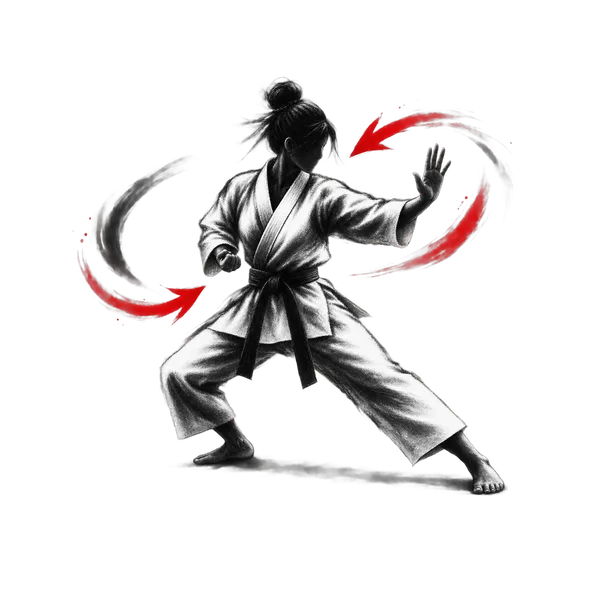
Two-way action means applying force in opposing directions simultaneously. While one hand pulls the wrist down, the other pushes the elbow up. The opponent's structure is caught between two vectors and has nowhere to go. This principle dramatically increases the effectiveness of every lock and hold without requiring additional strength.

12
Wrist Snap

Wrist Snap

A sharp, compact whip of the wrist.

The wrist snap is a quick, precise rotation at the end of a technique that amplifies its effect exponentially. Like the crack of a whip, the snap concentrates energy into a tiny moment and a tiny space. It's the principle that Ken Kawachi first showed Wally Jay - the seed from which all of Small Circle grew. Mastering the snap is what separates competent technique from devastating technique.

13
Pulsing & Waving

Pulsing & Waving

An undulating wave through the body.

Pulsing sends rhythmic waves of force through the opponent's body, each one building on the last. Rather than a single static application of pressure, pulsing creates a dynamic, undulating force that the body cannot adapt to or resist. Each pulse disrupts the opponent's structure a little more, until resistance collapses entirely.

14
Cascade Effect

Cascade Effect

One motion triggering the next.

The cascade effect describes how a single well-placed action can trigger a chain reaction through the body. A rotation of the wrist forces the elbow to bend, which pulls the shoulder forward, which drops the posture, which breaks the balance. One small input cascades through the entire structure. It's the ultimate expression of the small circle philosophy - minimal effort, maximum result.

15
Whiplash

Whiplash

A sudden dynamic recoil.

Whiplash is a sharp, sudden reversal of direction that catches the opponent's body mid-movement. As they resist in one direction, you snap the technique the other way - their momentum becomes your weapon. The suddenness of the change prevents the body from adapting, producing a powerful recoil effect that amplifies the technique beyond what raw force could achieve.

16
Entry & Exit

Entry & Exit

Step in; peel away.

Every technique has an entry - the moment you close distance, make contact, and establish control - and an exit - the moment you complete the technique and create separation. Mastering entry and exit means knowing how to get in safely, how to apply your technique with precision, and how to disengage cleanly. Poor entry gets you hit. Poor exit keeps you entangled.

Experience it

Feel the principles on the mat.

Reading about leverage is one thing. Feeling a perfectly applied small circle lock is something else entirely. Your first class is free.